Read more at www.thelongtail.com/the...
Talking about the devil ... now at least I know what took it so long. Although the FCC -issue shouldn't prevent them from launching this phone in Europe, does it?
Read more at gizmodo.com/gadgets/sma...
I was asked to write an article for the Media Morgen conference organised by VRT (national television and radio in Belgium) and it's website some time ago. But after all the energy I put in it they never published it. Too bad, but no worries, here’s an English version for you.
(By the way, if you already believe in CGC, start reading after the table.)
Creativity is what makes the difference between man and animals, and that creativity is constantly looking for a way to spread itself. It started with the prehistoric paintings in the caves of Lasceaux, boomed thanks to the invention of book printing and even Uncle Joe’s boring slide show is a proof of that. Luckily those slide show evenings are a thing of the past; today a wide range of tools is available to let our creativity blossom. The PC has become a semi-professional print shop, making bad photos is more difficult then making good ones (or you just shoot until you have a good one), load digital video into you PC, add a music track in MP3 format and in two hours you can cut and paste an entertaining piece of video together.
The obligatory slide show is being replaced by a CD, DVD or website (Flickr.com or Youtube.com) where family pics and videos can be shared worldwide. Friends on the other side of the country (or globe) can now too enjoy your work, whereas there is not obligation of those who happen to live close but are not interested in what you want to share.
With broadband becoming ubiquitous (at least in some countries) this evolution is truly booming. Anybody can spread his/her creations very cheaply (and simply) worldwide.
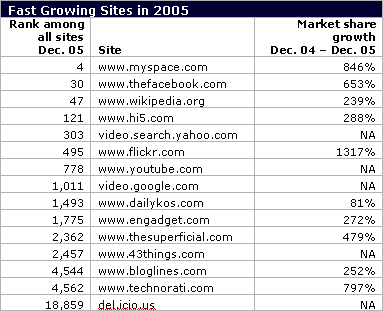
Just look at a number “consumer generated content” websites:
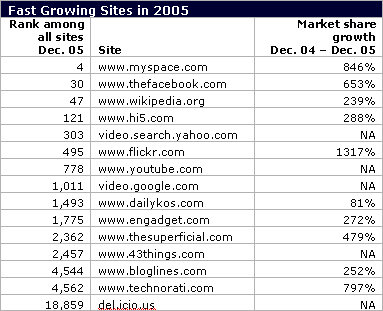
(source: iMediaconnection.com)
But what’s the secret behind this success? In the entertainment business democracy and consensus lead to average results. Soaps you watch half asleep and reading a newspaper at the same time are the result. Have a similar story that really happened told by someone who was there, and the result will be totally different. Less professional, but from the hart. A bunch of people will not like it, but a small group won’t miss it for the world. And that is the secret of consumer generated content. A community that consciously chooses to dedicate a part of it’s time and attention to for them truly compelling content.
The future of our leisure time will be increasingly taken up by this CGC. I expect that we will find 50% of our entertainment in the long tail of CGC. There will always be room for professional material, but a big part will be taken up by niche-content with which we feel a strong connection, something typical for the communities in which we spend our lives.
This means the role of journalists, program makers, TV/Radio stations, editors and publishers is fundamentally changing. The playing field is populated with new competitors, ranging from Skynet or MSN as a possible channel for publishing CGC, over Telenet’s iDTV of VodafoneLive (mobile) who provide an infrastructure, to mega-blogs like Engadget and zattevrienden.be who create their own channels. Everybody in this market wonders what their role will be. Medium or moderator, catalyst or filter, all options are open.
Offering platforms, both soft- and hardware, is already a very competitive terrain. MSN against Skynet, Belgacom ADSL against Telenet Internet and traditional publishers (HLN.be) have started the fight for the consumer.
Some people see the future of the professional media specialist in safeguarding the quality of what appears in the media. Intelligent journalists check their sources and only deliver quality, is what they say. On can argue about that, but more importantly this is old-school thinking. The consumer decides himself what he or she considers to be correct or relevant. And to help them out, there are a number of online tools, ranging from a simple voting system to complex algorithms that map out the relevance of an item. Check out memeorandum.com, bloglines.com or dig.com. The relevant content pops up automatically.
A truly innovative media company must embrace consumers and coach them in the development of good content. Teach people to handle new media, support them in their creativity and help to reach their audience. In this way even small regions (like the one I live in) can play a creative role in the world, with needing loads of cash and multinational structures.

I'm usually not the ranting type of guy, but all my electronic stuff seems to let me down.
Let's start with the gadget (well ... tool) I use most, my SonyEricsson P910i. Great phone, but oh so fragile. In fact I got it one year after my P900 died on me. I dropped it on the kitchen floor and the screen broke, took it back to the shop. They couldn't fix it, not because of the screen but because the inside of the phone had been humid ... (although the phone did work perfectly before the screen broke). Humidity? Well, the only thing I can imagine is that some sweat got in the phone when I was carrying it in my trouser pocket. Pffffff
Now, end of last year I heard about the P990 being launched in spring 2006 (with a decent camera build in, WiFI and a new Symbian OS), so I start dreaming (and saving). 8 months later the P990 is still in the "available soon" status. In the mean time, the flip-open keybord died on my, and I at least met two other people with the same problem. Fragile!
To hell with the P990, I'm going for another phone. In fact, I just bought a Sony Cybershot 100 (8.1 megapixel) camera, so my next phone could be an M600i, which has no build-in camera (if it only had Wifi ...).
Next piece of electronic junk is my iPod Nano. I bought one last October in the Apple store in Chicago. After a few months the battery failed and it got replaced (without a problem in a store in Belgium!). Again a few months later, the screen dies on met ... replaced again. And now the battery has broken down again. I'm taking it to the store next week, so I may end up with my third Nano in 10 months ...
NEXT! Dell ... Our company policy says we must use Dell computers. My laptop is my life, but apart from the horrible design of the Dell, I don't care to much for which brand it is. However, when it comes to audio and video, I grew up with a Mac (at home). So I'm a bit (only a bit) demanding on that side. Well, this Dell Latitude D610 SUCKS! First of all it doesn't have microphone ... Can you imagine that? A laptop in the age of Skype and Podcasting that won't allow you to record anything without plugging in an external microphone! BAD!
And it gets worse, the sound card on this thing isn't even close to the stuff in my mobile phone. Already when Windows starts up, you can hear a crack in the sound. Playing music over headphones is almost acceptable (although it sounds like an old record player with the disc skipping every now and then). Due to iPod failure I hooked up the laptop to my car stereo to listen to some podcasts while in a traffic jam. Total disaster! the sound is so bad it sounds as if somebody is knocking on the mike every 3 seconds on the other side.
PAUL, I want a MACBOOK PRO! (Paul is our sysadmin and übergeek)
I was really proud when my daughter sent her first e-mail about two years ago. With at hotmail account an a little help from dad (typing was a somewhat difficult) the electronic mail buzzed off to mom, and that’s where it ended. She hardly sent any mail since then. Not because she’s not on the computer anymore, on the contrary, madam (9 years old) spends more time online then in front of the TV.
But no more e-mail. The coming generation, for whom being online is standard, uses instant messaging (mostly MSN messenger) to communicate online. I don’t always get what they’re chatting about though, it’s communicating for the fun of it (I guess that’s the definition of chatting). When it has to be a bit more structured, the conversation moves to a blog or myspace (myspace.com: 37 million unique visitors in February 2006!). Some teenagers (especially in the US) live on myspace. Posts on their blogs succeed one another at a speed that outpaces many mailboxes.
And what about e-mail as a source of information? Is there anything more practical then a newsletter that keeps you informed of the changes on your favourite websites, without having to visit it? Yes there is, and it’s called RSS (Real Simple Syndication). Through an RSS feed your computer can receive the latest changes automatically, it’s a kind of (free) subscription. You organize your feeds just as you want, by subject, per type of site or simply chronologically, thus building your personal stream of information.
In fact, every type of e-mail today has a better alternative. And those alternatives have two things in common. One: they take ‘permission marketing’ one step further. This time the consumer decides him/herself to go and read a blog or refresh an RSS feed. Two: the interaction (response) is even easier and faster then clicking a button in an e-mail. It’s faster to type an answer in a messenger window, push enter and the message has already arrived. Faster, more interactive and totally under control, that’s the way the modern consumer want it.
This is my evolution theory:
Invitation > E-card > iCal
Courier > E-mail attachement > Online hard disc
Fax > E-mail > Instant Messenging
Letter > E-mail > Blog
Newspaper > Newsletter > RSS
And …, before all you marketer run of to your creative agency or media planner to get a communications plan build with these new media, remember this: consumers choose these channels because they have them under control and because interaction is easier. So be ready for that.
Arrived in Cannes yesterday afternoon. To us (living in Belgium) it's less then 2 hours flying, but we were in the plane with a guy from China who travelled a day. To him, this festival is really the event of the decade, whereas my collegue next to me (Michael) is here for the 15th time or so.
Yesterday I managed to catch at least part of David Eastman's speech (CEO of Agency.com) on integrated campaign. But REALLY integrated then, more then just re-working the same idea in different media (matching luggage as they call it in the UK apparently). Use each medium for what it is good at, and exploit it to the max.
Even though I have the privilige to work in one of the most integrated agency group (TBWA+Tequila+Agency.com in Brussels), we can still do better. In fact, we can always do better can't we?
Over the last months there have been a lot of discussions about the viability of Wikipedia. The consumer-build online encyclopedia is struggling with people who abuse the system by entering bad quality information or even intentionally wrong data (or self-promotion). On a whole, research says, Wikipedia is as reliable as the famous Encyclopedia Brittanica. But there are holes in the system, the editorial teem can't keep up with the 'bad guys'.
This cartoon shows why (The Internet Fuckwad Theory):
I don't know about the rest of the world, but over here we are spoiled with some would-be trendwatchers who mistake eventspotting for trendwatching. Yesterday I read a column which basically took one isolated phenomenon which occured at the other side of the globe (in a totally different culture), scratched together a number of events (not based ony research) and mixed the two together into an opinion.
Now I'm not an expert on the subject under discussion (spoiled kids), but my wife happens to be a "expert by experience" having been a teacher for years and now running a show where parents with kids come in on a daily basis. And she confirms my feeling. What may (may!) be a symptom of a trend over in the US (one city that is), is not even actual over here. Far from it being a 'trend'.
I value trendwatching very much and we'll need more of it to keep our businesses running in this fast changing world. But it's also a métier that has a difficult time getting credibility. So in the name of trendwatching, let's keep the quality up to standards please!
A good example of how it should be done? Go to www.trendwatching.com
As you can judge from the frequency of my posts, life is somewhat hectic around here. The evaluation of the Media Morgen conference is still due, but I did not want to withhold you this quote from Joseph Jaffe's latest podcast (with the guys from American Copywriter):
Old scool:
"No one ever got fired for putting TV on the plan"
Today:
"No one ever got fired for putting search on the plan"
I just love this one, probably gonna use it in my mail footer (or is that old scool too? :-) )
Helen Shaw had a good view on the future of radio during today's "Media Morgen" conference. I'll post some more notes later this week (too busy now), but wanted to share this with you already now.
In fact, at a certain point she talked about the evolution of radio starting with the first big & clunky radio's and ending with ... Podcasting (as a symbol of where we are going to). And actually, everybody today mentionned podcasting as if it's been there since for decades. Let's hope we can get Podcasting really going in Belgium now.
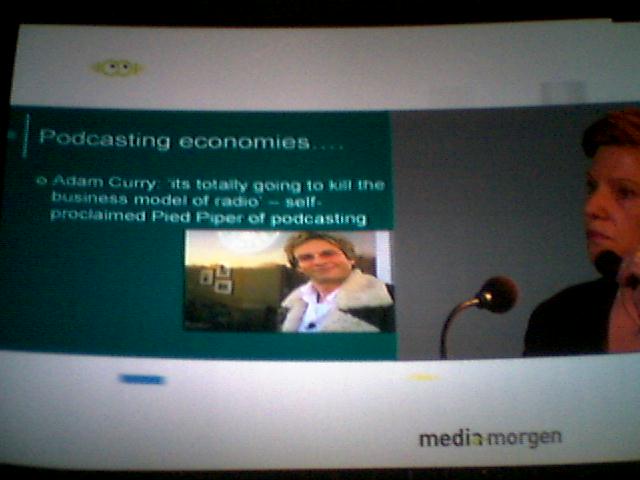
Check the slide where she mentionned Adam Curry (with picture!):
(Bad quality picture, I know. But I'm waiting for the new Sony Ericsson P990 to appear in stores)
VRT, the Belgian national TV station is launching a theme-week on new media. As of May 29th the focus will be on "Media Tomorrow" for a week, ending with a special show on sunday.
Ramping up to the week a number of opinion leaders give their view on the future of TV on a special website: www.mediamorgen.be.
Nu ook in het Nederlands op digimedia.be: Wie betaalt voor jouw aandacht, Windows Live of Gmail?
Microsoft has decided to release new developments in Google style. All kinds of applications in beta version are disclosed bit by bit. Anybody who regularly browses through www.live.com or labs.google.com can puzzle together the future. In the near future we will not choose for Windows, Linux of OSX, the internet is the platform of the future and then we will choose between Google or Live.com.
Away with Windows, OSX or any other operating system, the future is online. In a year or so, most of your computer activities will be conducted from a browser through a broadband connection. Reading your mail or instant messaging can already be done with only a browser in Gmail/GoogleTalk or Windows Live mail and messenger. The startup business is running at full speed again, developing all kinds of ideas to help entrepreneurs big and small to do business seamlessly with only a computer and a broadband connection. And seamless usually also means free, ‘no friction’ is the motto.
Windows is over with as a cash cow for Microsoft, you can just as well install Linux (for free). Kick Outlook out because Gmail is just as good (and works on my mobile too). But who will pay for all of this?
The answer is clear; the money will come from advertising.
And what will be used to attract advertisers: consumer attention!
“Attention” is the new currency of the online economy. Microsoft or Google will know exactly which search terms you use, what you are e-mailing or who you chat with. They can map out your personal network to the detail:
Chatters (soon split in business and leisure) are people who really know each other personally; e-mail means a more loose relationship. Bring that together with the search terms you use or your favourite websites stored in the Microsoft version of del.icio.us or ma.gnolia.com (favourites.live.com is available online) … and one can group together people with similar fields of interest. Can you see the three concentric circles symbolising your network in front of you?
Gmail and WindowsLive are not free at all; you pay them with your attention. So what if you don’t feel like selling your thoughts to a stock quoted multinational? Well, go check out http://www.attentiontrust.org, they offer you the possibility to log your online behaviour and should you like to, sell it to the highest bidder.
Get those interactive brains working to figure out how you can put these new possibilities to work as a marketer, advertising professional or entrepreneur. Pandora’s box is about to open!
I was asked to coach a student on an assignment about Podcasting. Actually, nobody in here school felt that they knew enough about podcasting to help her. So I got into the story a bit late with little time to help her out, but she still did a decent job.
Nancy, obviously, also made a podcast out of the document. And to make it look 'real' I promised to put the episodes on my servers space and in my feed. It's all in dutch and probably not the most compelling content, but any effort to spread the word on podcasting must be supported! The production value is more then decent so if you have some time to spare and understand dutch, go check it out. Feedback (send me a mail on bert-at-ibert.be) is welcome, I need to give points :-).
I'm not putting direct links to the episodes here because I find you should subscribe to the podcast feed (e.g. in iTunes) to get the real podcast feeling. This is the podcast feed: "http://podcast.ibert.be", use iTunes or any other podcatcher to subscribe to the feed and enjoy. Here's how that works in iTunes: click on "advanced" in the menu bar at the top, choose "subscribe to podcast" from the dropdown, past in the link above and subscribe.
Note:
All sources used in this podcast are neatly mentionned in Nancy's written assignment, so if you want info on that, drop her a mail: nancy.de.jonghe-at-telenet.be
Thursday night was a heavy party night. Reason were the Cuckoo awards, which are the annual Belgian awards for best direct marketing campaigns. Although I still think interactive marketing is as different from direct marketing as it is different from advertising, I'l still thrilled that we got onto the podium 3 times last thursday:
1. Innovation
With "The London Tapes Podcast" for Eurostar we got the innovation award. Being a podcast enthousiast and first-class geek this is obviously the one I'm most proud of. We were the first agency to use podcasting as a marketing tool, so I think that deserves an award. Be sure to keep an eye on the podcast feed, a new (improved) series is coming soon. More content, more interaction and also available in French now!
2. B2B (again for Eurostar)
Anybody who ever thought B2B marketing is boring by definition, surf to www.ikstopmetvliegenoplonden.be or www.jarretelavionpourlondres.be (for English, click here). We really got to involve travel managers into our story, and it's amazing how many reactions we got. Enjoy the 'flashy' book, the idea is based on the typical 'stop smoking' books.
3. Integration
Actually all three campaigns are joint efforts of TBWA, Tequila and Agency.com in Brussels. So the credit goes to all three of us. The integration award has a smaller online component (microsite, display advertising & paid search) but the off line guys really went all the way to convince people travelling by public transportation to work to get a new (cheap) insurance. (www.ikpendel.be, www.jesuisnafteur.be)
A lot of things have happened these last weeks that made me think ... impactfull events, simple encounters, new people entering my life and unfortunately a not so old one has left us. I don't know whether this blog is the best place to express some of my personal feelings, but hey, if you're not interrested just skip this post. There's a lot more to come today.
The good news is that people actually read my blog. I could have suspected that when checking the stats on google analytics, but I get more and more reactions from people on what I post. Unfortunately nobody seems to feel like writing something in the comments. So please, dear readers, drop me a note in the comments (click on "comments" below this post).
More good news is that a number of new people have joined Agency.com Brussels. So I finally get to concentrate a bit more on things I like doing best, like thinking up strategies, coaching people and working on the future of the agency.
Bad news on the family front however. A cousin of mine died last week and left his lovely wife and two children behind. Only 52 years old, no warning, 36 hours and ... gone. That really counts as a wake-up call for caring about your health. Damn Paul ... we're gonna miss you!
To end on a positive note, healthy action has been taken. The fitness room is equipped with a brand new "eliptical" (a kind of running machine), I'm cutting down on alcohol, balancing my food and putting more time into golfing again. Went to docter for a blood test (no results yet) and got my feet treated with a painfull injection so I can do sports without pain.
The first results ... my golf game is improving, I even hit a 240 meter drive on C5 in Oudenaarde this morning. :-)
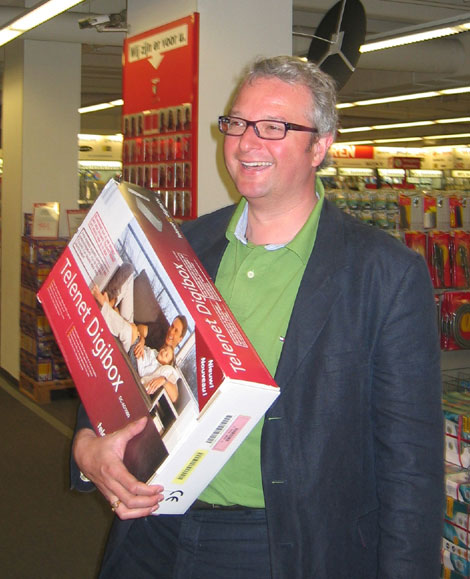
It took me a few weeks to decide, but finally couldn't resist. I bought myself a digirecorder (so I'm stuck with a 8 month-old digibox now). Not just an ordinary box with a hard drive, but an integrated set-top box that mixes digital TV and all it's advantages with the possibilities of hard-disc recording. It's our own little TIVO here in Belgium (well ... almost).
After only a few hours in the house the whole family is completely addicted! I thought I knew all about time-shifting, but you only really understand it when you start using it. Already our TV-watching habits have changed.
And what's so special about Digital TV in Belgium? Well, we have a broadband return channel. So the only real limiting factor compared to full internet is the resolution of at TV screen. Can you imagine the possibilities? Think of it as internet with DVD-quality video.
It gets even better, we have TWO providers of Digital TV here (Belgacom and Telenet). Why I chose Telenet? Well, they are definitively a year ahead (and we do their advertising :-) ).
Another post in dutch, sorry.
Heb met even uitgesloofd om uit te leggen wat Windows Live is, dan kan ik hiernaar verwijzen als de vraag nog eens opduikt. Het artikeltje staat op www.digimedia.be.